
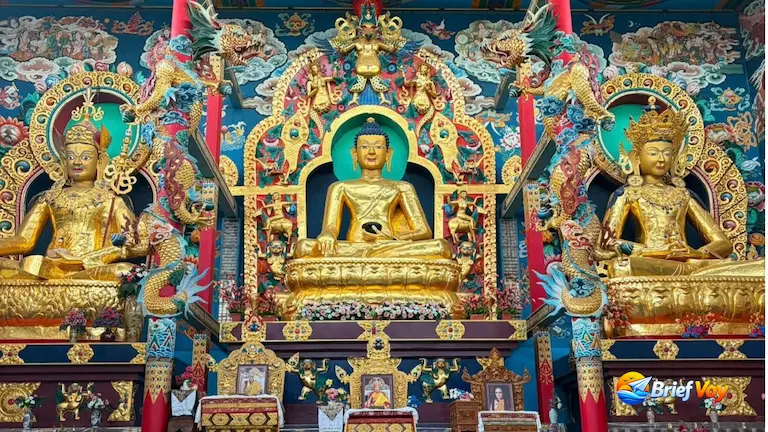
Bylakuppe’s Namdroling Monastery (the Golden Temple) feels like a quiet slice of Tibet dropped right into Karnataka. But getting your timing wrong here is a massive mistake.
Show up at a random hour, and you will likely hit heavy crowds, get stuck behind tour buses, and completely miss the afternoon prayers.
I verified these logistics on the ground so you can avoid that. Here is the actual truth about the Golden Temple Coorg timings, how to handle local auto fares, and where to find real Tibetan food just down the road.
Quick Facts for Your Visit
| Feature | Details |
| Official Name | Namdroling Monastery (Thegchog Namdrol Shedrub Dargyeling) |
| Timings | Commonly reported as 9:00 AM to 6:00 PM (verify locally as times vary) |
| Prayer Time | Usually around 1:00 PM or 4:00 PM (not guaranteed daily) |
| Entry Fee | Free |
| Parking Fee | ₹10 to ₹50 on my visit (Buses paid ₹100) |
| Location | Bylakuppe (6 km from Kushalnagar, 34 km from Madikeri) |
| Dress Code | Wear clothes that cover your shoulders and knees |
| Time Needed | 1.5 to 2 hours |
Complete Golden Temple Coorg Timings & Schedule
The main gates stay open most of the day. But you will enjoy your trip more if you know what the monks do all day. Namdroling is a real school and home for thousands of monks and nuns, not just a place for tourists.
Daily Visiting Hours
Visitor access is commonly reported to be from 9:00 AM to 6:00 PM every day. Keep in mind that these timings can sometimes change. It is always a good idea to quickly check with your hotel or a local driver when you arrive in town.
Want great photos without the loud noise? Try going between 9:00 AM and 11:30 AM. The sun looks beautiful on the gold roofs, and the big crowds are not there yet. You can also visit later from 4:00 PM to 6:00 PM. The air is cooler. It is a perfect time to just sit and watch the monks.
The Prayer Ritual (The Best Time to Visit)
Try to reach the gates by 11:30 AM. This simple trick saves you from the huge tour buses. Parking is much faster.
Many travelers report seeing hundreds of monks gather in the main hall for prayer chanting around 1:00 PM. However, other visitors have seen this happen later around 4:00 PM. It is not a guaranteed daily schedule, but if you catch it, the ritual is amazing. They chant and play Tibetan horns, drums, and bells. You can sit right on the floor and listen. Make sure you stay completely silent. Just grab a spot at the back and enjoy the peace.
Special Festive Timings (Losar & Saga Dawa)
Big festivals change everything here. Take Losar, the Tibetan New Year in February or March. You can watch the famous Lama Dance and see giant, bright paintings covering the walls. The prayers last for hours. Because it takes so long, little monks actually walk through the crowds to hand out water and snacks.
Saga Dawa happens every June to honor the Buddha. The 10th and 15th days of this month are extremely holy. If you plan your trip on those exact dates, get ready. The crowds will be massive.
Entry Fees, Parking & Logistics
You might wonder how much money you need. Here are the parking costs I saw and the ground reality of the area.
Is there an Entry Fee for Namdroling Monastery?
No. It is totally free for everyone to enter the Golden Temple. You do not need a ticket for the temples or the gardens. You can give a small donation if you want to help pay for the monks’ food and school, but you do not have to.
Parking Facilities and Costs
Entry is free, but you pay to park outside the gates. Here is what they were charging during my visit:
- Two-wheelers: ₹10 – ₹20
- Cars/SUVs: ₹30 – ₹50
- Mini-buses and Tourist Buses: ₹100
Ground Reality of the Parking Area & Restrooms:
The main parking lot is a short walk from the temple gate. It is just a big dirt field. Since there is no concrete, it gets very muddy and slippery when it rains (June to September). Wear old shoes if you go during the rainy months.
The public toilets are right next to the parking lot. They are very basic but clean enough to use quickly. Bring your own tissue paper and hand sanitizer just to be safe.
Traveler Tip: On big holidays like Diwali or Christmas, the small road to the monastery gets stuck with traffic. Try to reach before 10:00 AM to park easily.
A Glimpse of History: The 1963 Bamboo Tent
It helps to know how the Golden Temple started. It was not always this big.
In 1959, a Tibetan leader named Penor Rinpoche came from Tibet. The Indian government gave the Tibetan refugees some jungle land in Bylakuppe so they could live safely. In 1963, Penor Rinpoche established the Namdroling Monastery. At first, it was just a very small bamboo temple. He lived in a simple tent. Life was very hard. The monks faced wild elephants, bad sickness, and had no money.
Today, it is one of the world’s largest Nyingma Buddhist teaching centers. Thousands of monks and nuns live there now.
Understanding the Architecture: What to See Inside
A lot of people just walk into the main room, take a picture, and leave. But the campus is huge and has other buildings you should see.
1. Padmasambhava Buddhist Vihara (The Main Golden Temple)
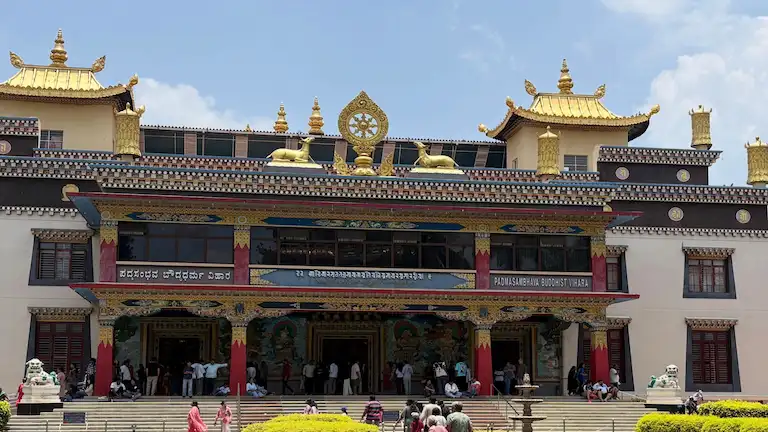
This building opened in 1999. This is what everyone calls the “Golden Temple.” When you step inside, you will see three huge gold statues:
- Center: Buddha Sakyamuni (60 feet tall)
- Left: Guru Padmasambhava (58 feet tall)
- Right: Buddha Amitayus (58 feet tall)
The walls have bright paintings that show stories of the Buddha, gods, and demons. Inside the big statues, they put small holy items and prayer books to keep them safe.
2. Zangdog Palri Temple
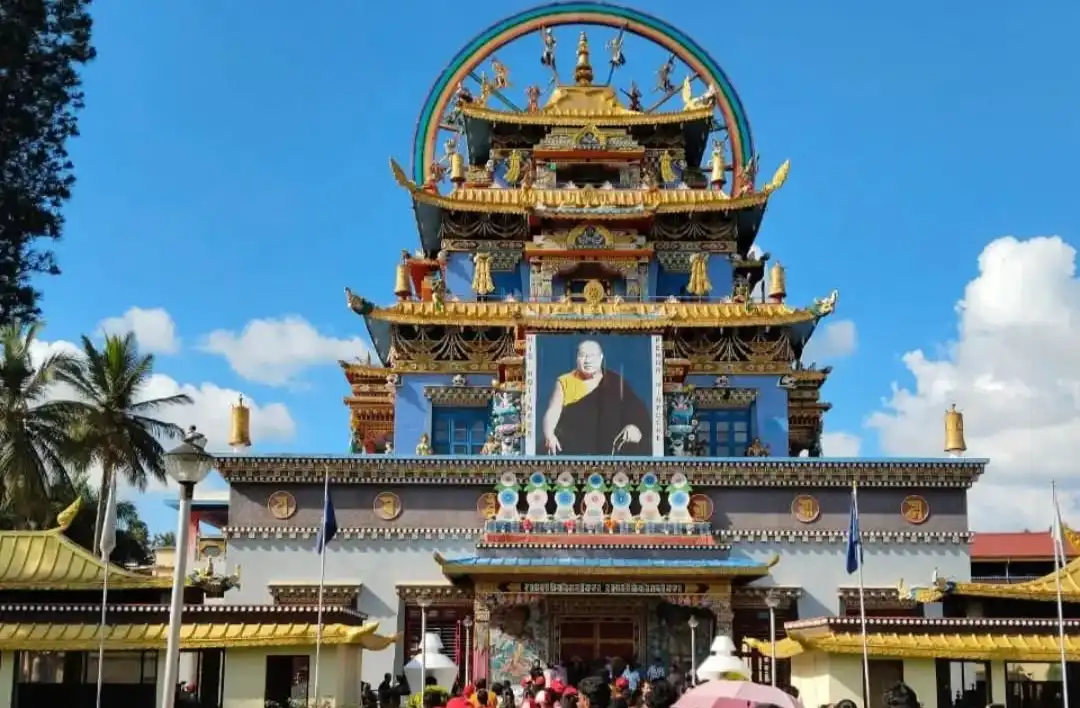
This temple sits right behind the main hall. The building opened in 2004 to honor Guru Rinpoche. Painted in very bright colors, the structure looks just like a holy copper-colored mountain.
3. Tara Temple
Just walk behind the main hall and you will see the Tara Temple. It honors Tara, a female Buddhist figure. The main building often gets very loud and packed with tourists. When that happens, just walk over here. It is much quieter. You can sit down and relax.
Visitor Etiquette & Photography Rules
This is a real place of worship. It is not just a tourist spot for photos. Keep these basic rules in mind to respect the monks.
The Kora (Clockwise Movement)
Tibetan Buddhists pray by walking in circles around holy items. They call this a Kora. You always need to move clockwise. Walk from left to right when going around buildings or stepping into a room. The same rule applies to the prayer wheels. Just remember to use your right hand to push them.
Dress Code & Footwear Micro-Logistics
Wear clothes that cover your shoulders and knees. Please do not wear shorts, tank tops, or short skirts. Most visitors leave their shoes and socks on the wooden racks by the doors before walking inside any temple. Just watch what the crowd does and follow along.
Photography Restrictions
Take all the photos you want of the gardens and buildings outside. Inside, you can usually take pictures of the big statues. Just turn your flash off. As a point of basic respect, try not to turn your back to the Buddha to take a selfie. It is polite etiquette here. Always follow any posted signs about photography, and it is best to completely put your phone away if prayers are underway.
General Conduct
Keep your voice down when you walk around. Do not touch the statues, paintings, or any holy items. Please do not try to shake hands with the monks. I also recommend leaving your dogs and other pets at home, as animals are generally not seen inside the temple areas.
Food & Dining: Exploring Tibetan Camp 1 & 4
Many tourists skip the local Tibetan food right outside the gates. That is a big mistake. The area has numbered “Camps”. Walk over to Camp 1 or Camp 4 for cheap and amazing food instead of the normal tourist cafes.
Note on Timings: When I visited, I noticed these local restaurants closed very early. I had to sit down and order my dinner by 7:00 PM, so go early just in case.
Must-Visit Restaurants in Bylakuppe
If you want to eat outside, go to The Tibet Kitchen Rooftop in the 4th Camp. It is right near the main road to the temple, and the food tastes very real.
Taste of Tibet on 1st Camp Road is a small family spot that is a bit hard to find, but it is worth it. During my visit, they were serving spicy cold noodles called Laping for ₹60 and Chicken Thukpa for ₹120. You can also try their soft steamed bread (Tingmo) and fried meat (Shaptak).
For a quiet place, Peace Restaurant is great for eating hot beef or chicken momos after a long walk. And here is a quick local tip: if you order thick noodle soup (Thenthuk) and they are sold out, just ask for regular noodle soup (Thukpa) or momos in hot soup (Mothuk).
How to Reach Namdroling Monastery
Bylakuppe is right on the main road connecting Mysore and Madikeri.
From Kushalnagar (6 km)
The Kushalnagar bus stand is very close by. It takes just a few minutes to get to the temple gates.
From Madikeri (34 km)
Most people stay in this main Coorg town. A taxi or a local bus will get you to Bylakuppe in about one hour.
From Mysore (85 km)
The monastery is right next to National Highway 275. People driving up to Coorg often stop here for a quick break.
Exact Auto-Rickshaw Logistics & Fares:
You can easily find an auto at the Kushalnagar bus stand. They will drop you right at the temple gate. A driver initially quoted me ₹200 for a private ride. But after talking to him, I actually paid between ₹100 and ₹150. Make sure you agree on the price before you get in.
To save a little money, look for the larger shared autos waiting near the same bus stand. I only paid ₹20 to ₹30 for a single seat on my trip.
Frequently Asked Questions (FAQ)
How much time is required to visit the Golden Temple in Coorg?
You need about 1.5 to 2 hours. This gives you enough time to see the main hall, walk to the smaller temples, spin the prayer wheels, and just sit and relax.
Are there wheelchair facilities available?
The ground outside around the campus is mostly flat and easy to push a wheelchair across. However, you should try to check ahead to see how accessible the stairs and main prayer hall are on the inside.
Can I stay overnight at the monastery?
It is much easier to just book a hotel room in Kushalnagar town, which is very close by.
Are there any guides available?
I did not see any official tour guides waiting at the gate on my visit. But the staff and older monks are very friendly and will answer your questions. You can also just read the large signs near the temple doors to learn the history.
What is the best month to visit?
You can visit during any month. Personally, I think the weather feels best from September to February. If you go during the Tibetan New Year (in February or March), you get to see their amazing traditional dances.
Planning a longer trip? Pair this visit with the Gokarna beach trek along the Karnataka coast.
About the Author: Bijoy Pal is a travel writer who only writes about places he actually visits. He went to Coorg and Bylakuppe himself to find all these real details for you. He shares exact auto prices and local secrets in his destination guides so you can avoid tourist traps and just enjoy an easy, stress-free holiday.