Physical Address
Bankura, West Bengal 722142
Physical Address
Bankura, West Bengal 722142

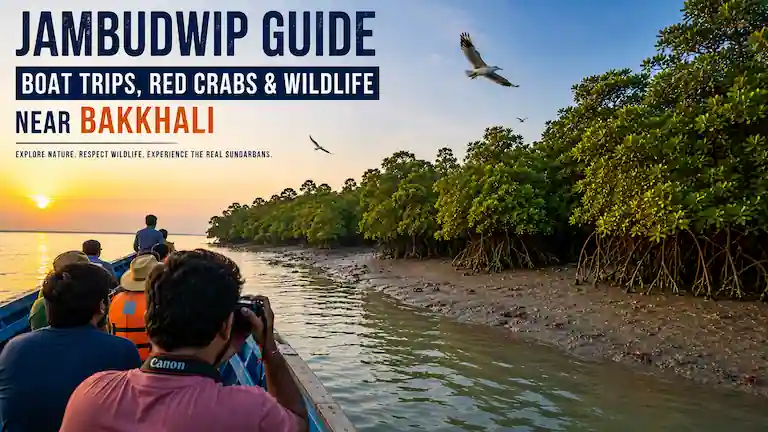
Most people hit the Bakkhali beaches for the usual routine, but I’ve always been drawn to that low, green line of mangroves on the horizon. That’s Jambudwip. It’s a protected coastal reserve, and one of the last wild spots we have left.
If you’re planning a trip, you’ve likely seen the rumors. Search for “things to do” there, and you’ll find a lot of outdated or misleading advice. Too many “travel experts” suggest you can walk on the island—don’t. You’ll ruin a delicate ecosystem and likely run into trouble with the forest guards.
After spending a lot of time in the Sundarbans, I’ve realized something—Jambudwip isn’t even about the beach. It’s the water. Just don’t try to land there. Keep your distance, stay on the boat, and let the animals have the place. That’s the real way to see it.
| Feature | Details |
| Distance | ~8 km from Fraserganj/Bakkhali coast |
| Best Time to Visit | November to February (Winter season) |
| Estimated Cost | ₹150 (shared boat) – ₹6,000 (private charter) |
| Trip Duration | 1.5 to 3 hours |
| Key Rule | Strictly No Landing (Protected Forest Reserve) |
Jambudwip? It’s basically just this tiny, empty island sitting about 8 km out from Bakkhali beach. A lot of people hear “Sundarbans” and assume it’s some kind of vacation spot, but let me save you the trouble—it’s not. There aren’t any hotels, no shops, and definitely no tourists allowed. The government keeps the whole place under really strict protection, mostly just so the mangroves and the wildlife can actually do their thing without humans messing it up. It’s one of the last truly wild, untouched spots around here, and to be honest, it’s probably better that way.
It is important to understand that Jambudwip is not a regular beach or a holiday resort. It is a vital, protected nature reserve. Under the Indian Forest Act and local government rules, the island is a protected forest area. The mangroves here act as a natural wall against big storms, and they serve as a safe nursery for sea life and many rare birds.
Some travel blogs might suggest that you can walk on the island’s sand, but that is both wrong and illegal. The rule against landing is not just a suggestion; it is the law. The forest department strictly bans people from entering the island to protect the delicate mudflats and the birds’ nests. By staying on your boat, you help keep the island a safe home for the migrating birds and the thousands of red crabs that live there.
The best part of this trip is not stepping on the sand—it is seeing the island from the water. If you go expecting a beach walk, you might be disappointed. But if you go for the boat ride—to feel the cool salt spray, watch the wild green forest from the deck, and follow the local conservation rules—you will have a much better time. Seeing this wild, green treasure from the water is the only responsible way to enjoy it.
Getting to the Fraserganj jetty? Not exactly a walk in the park. But look, it’s totally doable if you’re smart. Start early—I mean really early. If you are taking a road trip, checking the exact Kolkata to Bakkhali distance will help you time your drive to dodge the morning market traffic. If you prefer public transit, catch a train from Sealdah or Howrah, or a bus from Esplanade. Just make sure you hit Namkhana, cross the Hatania-Doania creek bridge, then head straight to Bakkhali or Fraserganj to dump your bags. Once you’re settled, just flag down a “toto” or auto-rickshaw. Tell them, “Fraserganj Fishing Harbour Jetty.” That’s where you’ll find the boats and finally get the trip started.
Heading to Jambudwip? Just remember it’s a protected reserve, so think of it as a nature cruise, not a beach day. Getting to the harbor from Bakkhali is actually pretty simple. Just grab a local “toto” or auto from your hotel and tell them you’re heading to the Fraserganj jetty. It’s cheap, fast, and the ride through town is fun. Pro-tip: get there early. Like, really early. The fishermen are out, the light is gorgeous, and you’ll get out on the water before the midday sun makes everything miserable.
Once you’re at the jetty, the boatmen will start coming up to you. Don’t worry, you’ve got two easy ways to go. If you’re like me and prefer to keep the budget low—or if you just like meeting new people—grab a seat on a shared boat. It’s about ₹150 and you’ll be with other travelers. But if you’re a photographer or you just really want some peace and quiet to watch for birds, just hire a private boat. It’s obviously going to cost you more, but having the whole boat to yourself to go at your own pace is worth every penny.
Because Jambudwip is a protected reserve, you might need a bit of official clearance to cruise the waters near the island. It’s usually just a small fee, maybe ₹50 to ₹100 per person, to help with conservation. Don’t stress about the paperwork, though. Just ask your boatman when you’re at the jetty, “Is the forest clearance fee included in this?” A good, local operator knows exactly how to handle it. It’s the easiest way to make sure everything stays legit without giving yourself a headache.
The island is only about 8 to 10 km out, so you’re looking at maybe an hour and a half or two hours on the water. It’s the perfect half-day outing. You’ll be back with plenty of time to grab a late lunch and just collapse on the sand at Bakkhali beach, or start planning your next day’s trek to a completely different, secluded coastal landscape like the one in our Baguran Jalpai guide.
Since you can’t step onto the island (it’s a protected home for plants and animals), your trip is all about seeing nature from the water. Here is how to enjoy your boat ride:
The best part is honestly just being on the boat. As you sail out to where the river finally hits the Bay of Bengal, the views of the wild, green forest and the water are just unreal. It’s the easiest way to feel like you’ve actually stepped away from the world and into the middle of nature.
If you’re into photography, bring your camera. The whole area is just a goldmine. I mean, just the way the light hits the mangroves and the water? You’re going to get some wild shots out there. And look, you don’t need to be a pro or anything. Just stand on the deck and snap away—it’s actually pretty hard to take a bad picture in a spot like this. You’ll walk away with something cool, even if you’re just messing around with your phone.
Out there? It’s just, like, weirdly silent. You honestly don’t realize how loud the city is until you get to a spot like this. Just tell the boatman to cut the engine for a bit—seriously, do it—and just sit there. Don’t talk. Just listen to the waves and the wind. It’s the best way to actually clear your head. Forget the phones, forget the noise, just listen. It’s pretty wild.
You are visiting the spot where the land meets the sea. Watch closely as the water changes the shape of the island’s edge. It’s a very special, shifting landscape that most people never get to see this closely.
Jambudwip is basically a wild sanctuary. Since you’re just passing by on a boat, you get a solid view without bothering the animals. Keep your eyes glued to the mud banks. You’ll see these bright, fiery red dots moving everywhere. Those are the mangrove crabs. They’re tiny, but they come out in these huge groups and just zoom across the mud. It’s actually pretty funny watching them pop in and out of their burrows when the tide drops. Probably my favorite part of the whole ride.
Also, bring binoculars. Don’t forget them. This place is a massive pit-stop for birds. Depending on when you go, you’ll catch gulls or terns diving for fish, or maybe even big birds of prey circling way up high. And don’t just stare at the sky. Look at the trees, too. The mangroves. It’s wild if you think about it—how they figured out how to grow in salty, tidal water? Nature is just tough. That’s all there is to it.
If you’re planning on Jambudwip, forget the summer. The monsoon season is way too rough and honestly just sketchy for a boat ride. You’re better off waiting for winter—anytime from November to February is the sweet spot. It’s actually cool enough that the long ride out doesn’t feel like a chore. And get an early start. I’m talking 7 or 8 AM at the latest. The light is incredible then, and you’ll be back before the midday sun fries you.
Also—and this is the biggest thing—check the tides. Don’t just show up. You want low tide, period. If you end up there at high tide, you’re pretty much out of luck; the water covers everything and you’ll be staring at empty waves. Low tide is when the mudflats show up, and that’s when you’ll actually see the crabs and the birds hunting. I know, trying to time everything with the tides is a total headache. It’s either that or spending your whole day sitting in a boat seeing absolutely nothing.
First off, don’t waste your time looking for a hotel on Jambudwip. You won’t find one. Period. It’s a protected nature reserve, which means it’s totally empty and wild. No camping, no hotels, nothing. You’re not even really supposed to step foot on the sand there.
And hey—if you see those ads for “Jambudwip Resorts” online? Just ignore them. They’re totally misleading. Those places are definitely not on the island. They’re just back in Bakkhali, Fraserganj, or maybe over on Mousuni Island. Don’t let yourself get scammed by that.
The smartest move is just to grab a room in Bakkhali or Fraserganj. There’s a ton of stuff there—you can find cheap, basic lodges if you’re on a budget, or nicer spots if you want a view of the beach. It’s way less of a headache to just stay in one of those towns and hire a boat for a quick day trip. It’s the only way to do it.
Don’t even think about building on Jambudwip. It’s off-limits. But that’s actually fine, because the real potential is in towns like Bakkhali or Fraserganj anyway. More people are showing up here every single year. It’s opening some doors for anyone wanting to do something a bit different—and hopefully, eco-friendly.
It’s wide open for anyone willing to try something different. A legit, cozy homestay? People love that. They’re over the stuffy, soulless stuff. And the tours? Everyone wants a guide who actually knows the water—not just someone reading a script. If you can put together a trip that doesn’t feel like a total tourist trap, you’re already miles ahead of the pack.
The service level is the biggest gap. People are tired of the same old mess. Start a boat service that’s actually clean. Don’t treat the ocean like a dump. Just doing the basics—being professional, respecting the water—makes you stand out instantly. It’s not about some fancy “eco-tourism” label. It’s just about running a business that doesn’t ruin the place. That’s how you win.
Heading to Jambudwip? Good choice. But listen—you gotta be ready. That sun reflecting off the water? It’s brutal. Bring a hat, shades, and enough sunscreen to cover an army, or you’ll regret it by noon. And water—pack way more than you think you need. You’ll be thirsty. Also: listen to the boatman. If they say the tide is acting weird or the sea looks grumpy? Just listen to them. They’ve been out there forever. They know what’s up. It’s not worth risking your neck.
Now, about the island. Let’s keep it clean, yeah? Treat it like it’s your own backyard. Personally, I always keep an extra plastic bag in my pocket just for trash. Because things blow away—wrappers, napkins, whatever—and once it’s in the water, it’s gone. That’s bad news for the birds and the fish. Just pack your junk back to the mainland. Simple as that. It’s not much effort, but man, it makes a massive difference.
Most folks heading to Bakkhali just stick to the main beach. And look, I get it—it’s relaxing. You’re missing the real magic if you don’t hop on a boat and check out Jambudwip. It completely changes the vibe of your holiday. Suddenly, it’s not just another boring beach trip anymore; it actually feels like you’re doing something, you know, an actual adventure.
There’s this one part, right when you’re out on the open water looking back at the shore—you see this massive, thick wall of green mangroves. It’s wild. It kind of hits you out of nowhere how huge and ancient that landscape is. It’s a total reality check that nature is the one running the show out there. For a few hours, you aren’t just some tourist wandering around—you’re basically a guest in a place that’s been doing its own thing for centuries. It’s pretty special.
Yes, but only if you use a registered boat from Fraserganj Harbor. The local boatmen know the water well. Just make sure to check the weather before you go.
It’s a bad idea. The water around the delta mouth is tricky. There are strong currents and plenty of jagged logs hidden just under the surface. You’re much better off just enjoying the view from the deck.
If you’re okay with a shared boat, you can just show up at the Fraserganj jetty in the morning. Easy. But if you’re looking for a private boat—especially in the peak winter rush—definitely call a day early. You don’t want to show up and find nothing available.
Nope, not at all! “Jambudvipa” in the old texts is just this grand, mythical concept. The island near Bakkhali is just a regular piece of land that got its name from the Jamun trees growing there.
Looking for more cool spots to hit up? Check out our Complete Bakkhali Sea Beach Guide, or browse all our expert-recommended trips in our Destination Guides. And hey, if you’re stuck on anything else, just drop a comment below.