Physical Address
Bankura, West Bengal 722142
Physical Address
Bankura, West Bengal 722142

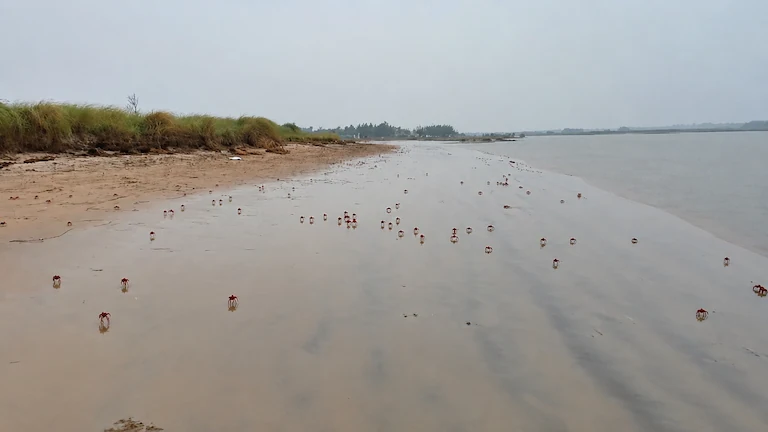
Most people look at Google Maps and assume they can just drive straight across the Pichaboni River from Mandarmani to Tajpur. In reality, this massive natural barrier completely controls your trip, dictating your travel schedule and deciding whether your car will end up buried in the deep sand.
While generic blogs just call it a pretty sunset spot, we skip the fluff at BriefVoy. If you want the actual ground reality—how to safely navigate the estuary, where to stay, and how to avoid local transport scams—this is the only guide you need.
To understand how to travel around it, you have to understand what it is. The Pichaboni River is not a gentle stream; it is a dynamic, fast-moving tidal channel.
Why can’t you just drive across at low tide like on other beaches? The answer lies in the water’s movement and scientific hydrology.
According to coastal hydrodynamics research on Purba Medinipur tidal inlets (such as studies by Chaudhuri et al. on the hydrodynamic stability of the Pichaboni inlet), the river features a prominent reverse hydraulic gradient. In simple English: during high tide (Joar), the ocean water surges up the river much faster and harder than it drains out during low tide (Bhata).
Further inland at Serpurjalpai, the water flow is heavily blocked by a massive Sluice Gate. This gate controls the water to protect the surrounding villages from flooding. Because the ocean water is bottle-necked by this gate, the currents at the river mouth become incredibly aggressive. The sand moves constantly (dynamic bed-load sediment movement), turning what looks like a flat driving path into a deep, dangerous mud trap (silt).
This is the biggest question people ask. You stand at the edge of Mandarmani, look across the water, and see the Tajpur hotels right there. They look so close! So, can you cross the river?
Yes, but you cannot go straight across.
| Route Name | Distance | Vehicles Allowed | Travel Time | Road Condition & Landmarks |
| Main Highway Route (via Chaulkhola) | 34 to 38 km | Cars, SUVs, Bikes | 1 hour 15 mins | Good paved road (NH 116B). Goes through Balisai and crosses the main bridge. |
| Village Path (Sluice Gate) | 14 km | Bikes or Walking only | 40 mins | Narrow mud and concrete village lanes. Cars cannot fit here at all. |
| Local Wooden Boat | 300 meters | Walking only | 10 mins (plus waiting) | Small fishing boats at the riverbank. There are no fixed timings. |
If you want to take your car from your Mandarmani hotel over to Tajpur, you have to take the long way. Here is exactly how to drive there:
If you are staying in Mandarmani, reaching the Pichaboni Mohana (where the river meets the sea) is an adventure. Walking from a hotel near the western end to the eastern end is exhausting.
The best way to reach the estuary is by hiring a local motorized cycle-van (known locally as a Vano or Toto).
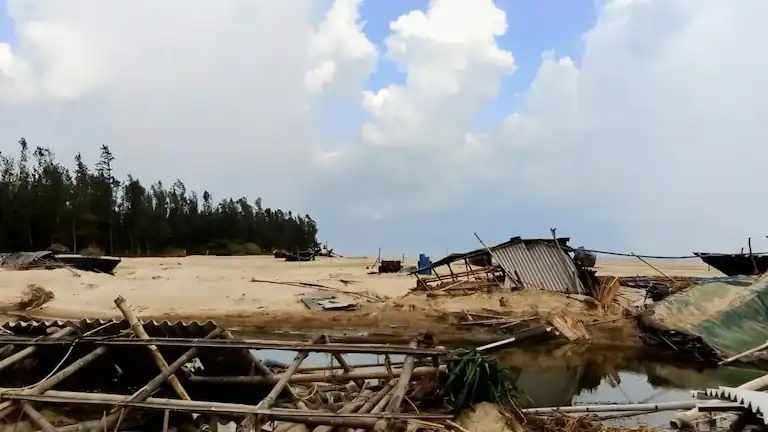
As you approach the estuary, the luxury resorts disappear. You enter Dadanpatrabar Khoti—a massive traditional fish landing and drying center. This is the cultural heart of the estuary.
If you take the small wooden boat ferry across (which takes about 10 minutes and costs ₹50-₹100), or drive the 35 km long way around via the Balisai highway, you will arrive at the eastern bank of the Pichaboni River.
The geography here changes instantly. Instead of wide open sand, you are greeted by deep red clay and thick Casuarina trees. If you look closely from the Mandarmani side, you can see specific landmarks like the Mohana Beach Resorts sitting right near the trees on the Tajpur bank. This side is much quieter, with fewer food stalls and much less vehicle traffic.
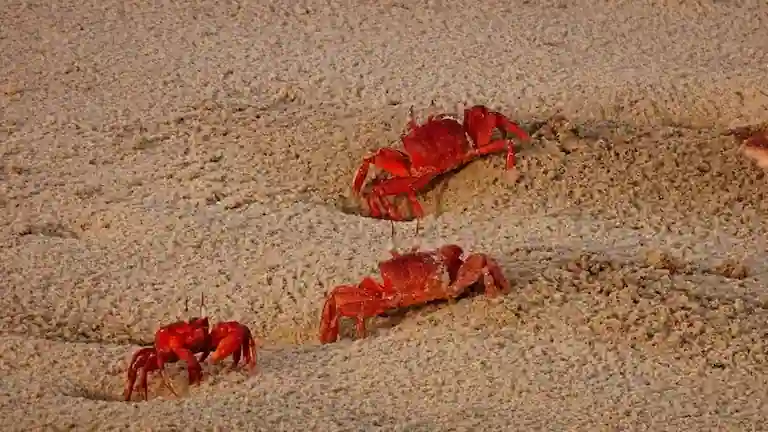
You cannot talk about the Pichaboni River without mentioning the famous Red Ghost Crabs (Ocypode macrocera). When the tide goes out, millions of these bright red crabs come out of their holes, turning the river banks into a red carpet.
To see them, you must visit during absolute low tide and stand perfectly still, as they are very shy and will hide if they feel footsteps.
Want to know the exact tide timings to see the crabs? Because the ecology of the crabs is complex, read our full breakdown here: Lal Kakra Beach: Mandarmani’s Red Crab Coast & Tide Guide.
The locals track the tides obsessively, and so should you.
Driving your private car directly on the Mandarmani beach and near the Pichaboni estuary silt bed is illegal. The National Green Tribunal (NGT) has strict rulings to protect the coastal sand dunes and red crab habitats.
If you ignore this and try to drive your car to the river mouth, you will likely sink into the silt.
Coming from Kolkata? Here is the easiest way to get there by road.
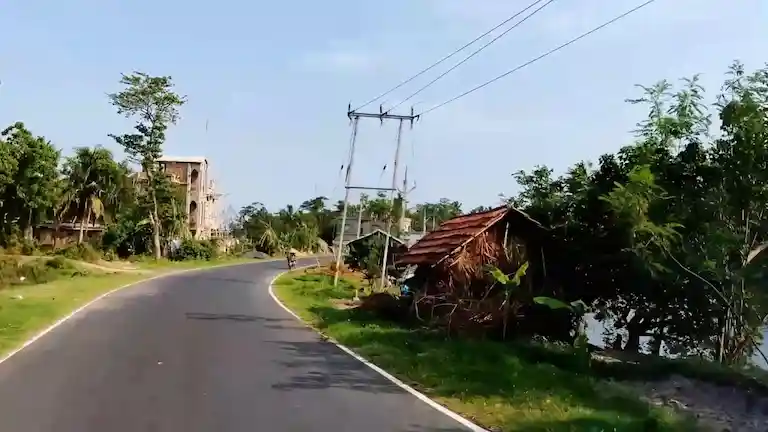
First, get on the NH16 (Mumbai Road) highway and drive up to Nandakumar. From there, take the turn for the Contai-Digha road (NH 116B). Keep driving until you see the Chaulkhola crossing, and then take a left turn towards Mandarmani.
Follow that road straight to your hotel. Once you drop your bags, leave your car behind. The best way to reach the actual water is to hire a local Toto from your hotel. Just tell the driver to take you to the very end of the beach at Dadanpatrabar, and they will drop you right at the river.
Got just one day in Mandarmani? Here is an easy way to plan your trip.
Get up early at 6 AM and catch a Toto to the Dadanpatrabar fishing area. It is really cool to see fishermen bringing fresh fish on their wooden boats. Wait around until 8 AM when the water drops. The wet sand fills up with thousands of tiny red crabs running around. After that, you will probably be starving, so head back to your hotel for breakfast and a quick nap.
Around 3 PM, take a walk on the main Mandarmani beach. Make sure you buy some hot, fried Pomfret or Bhetki fish from the small local beach shops.
Head back to the river side at 4:30 PM for a great sunset view. Just ask a local if the water is low first. Make sure you leave by 6 PM before it gets completely dark. There are zero streetlights out there, so it is much safer to get back to your room early.
Got some extra time? You can easily check out a few more spots near the river.
If you want to wake up close to the river and the fishing boats, you need to book a room at the very end of Mandarmani beach. People usually search for “Serpurjalpai Pichaboni River Estuary Road hotels” to find this exact spot.
Here are a few good places to stay in this area:
Since this side of the river is totally empty and natural, keep your packing simple:
Your phone can easily trick you near the Pichaboni River. Here are two real tech problems you need to watch out for:
If you set Google Maps to “Car” mode, it correctly shows the 35 km route around the river. But if you switch to “Two-Wheeler” or “Walking” mode, the app might draw a line straight through the river water! It assumes the low-tide sandbars are a real road. Bikers following this route have ended up stuck in deep, sinking mud. Always keep Google Maps set to “Car” mode.
Once you leave the main hotel area and head towards the river mouth (Dadanpatrabar Khoti), mobile networks like Jio and Airtel usually lose signal completely.
Because there is no internet signal, online payment apps like GPay, PhonePe, and Paytm will not work. Some local van drivers and boatmen take advantage of stranded tourists without cash, charging extra or forcing expensive trips back to an ATM. Always carry ₹500 to ₹1,000 in cash (using ₹50 and ₹100 notes) to pay for your rides, boat ferry, and local seafood.
Visiting the Pichaboni River is the best part of going to Mandarmani. It is a quiet break from the crowded hotels. You get to see real fishermen at work and watch how fast the water changes.
Most tourists ruin their weekend trips because they don’t know the area. Just remember a few simple things: visit during low tide (Bhata), take a Toto instead of getting your car stuck in the mud, and remember that Tajpur is a long 35 km drive, even if it looks super close across the water.
Forget the fake maps online. Stick to what actually works on the ground.
No. The river completely cuts off the beach, and there is no bridge. You have to go back to the main highway and drive 35 km through Balisai to reach Tajpur.
No, please don’t. The water pulls very fast here, and the sand is extremely loose. Your feet can easily get sucked in. It is not safe at all.
A Toto (or Vano) will charge ₹300 to ₹500 from the main hotel area. This covers your up-and-down trip, plus the driver will wait about 30 minutes for you.
There are no regular ticketed boats. But you will find local fishermen at the riverbank. They can drop you to the other side in their small wooden boats for just ₹50 to ₹100.
Bijoy Pal Travel Writer & Founder of BriefVoy
At BriefVoy, we get straight to the point and share real, helpful travel guides. We visit these places ourselves to check ticket prices, driving distances, and transport details. Explore our full collection of destination guides to plan your next trip easily and avoid any bad surprises.