Physical Address
Bankura, West Bengal 722142
Physical Address
Bankura, West Bengal 722142

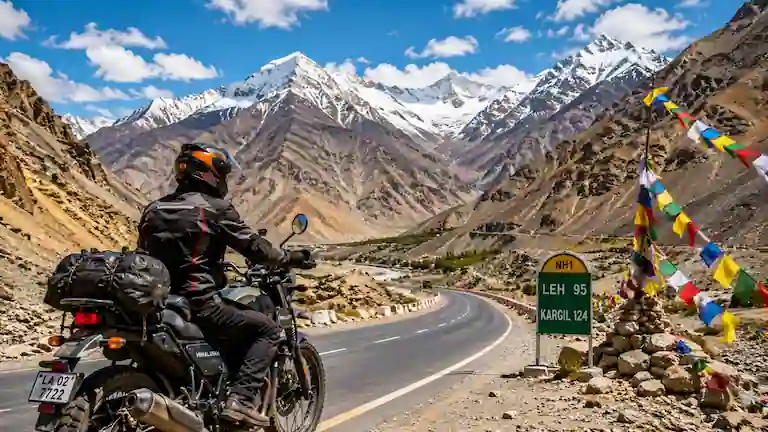
Planning a road trip across Ladakh? Getting advice from someone who actually drove this road will save you a lot of stress. Many travel websites say the drive from Leh to Kargil distance takes just 4 hours. That is almost never true. Normal map apps completely miss the heavy mountain traffic, slow military trucks, and what it is really like to drive so high up in the mountains.
To give you the real facts, I timed my own trip on this exact road in early June 2026. I rode a rented Royal Enfield Himalayan motorcycle. Even with clear skies, the strong mountain winds slowed me down. The whole trip took me exactly 6 hours and 15 minutes.
In the guide below, I share the real driving times, the true road conditions for the NH1 highway, current bus times, and a few safety tips you really need before your phone loses its signal.
Note: Every single price, bus time, and road detail in this guide has a “Last Verified” date. You can trust that this information is new and checked in real life.
Custom Map & Offline GPS Download
- Live Map: View our custom Google Map with all 5 major stops, fuel stations, and police checkpoints pinned here: Open Leh to Kargil Custom Google Map.
- Offline Navigation: Click here to download the exact GPX/KML track.
Pro Tip: Cell phone service drops completely on this route. Download this file to your phone and open it with an offline map app (like Maps.me) before you leave Leh.
Short on time? Here is a fast, easy summary of the trip based on my actual drive:
The straight distance from Leh to Kargil on National Highway 1 (NH1) is 219 kilometers.
Google Maps often says this trip takes only 4.5 hours. When you are driving in the high Himalayas, that is almost impossible.
Here is the real time it takes based on how you choose to travel:
| How You Travel | Real Travel Time | Average Speed | Best For |
|---|---|---|---|
| Private SUV or Taxi | 5 to 6 Hours | 40 to 45 km/h | Families who want a fast, easy trip |
| Motorcycle | 6 to 7 Hours | 35 to 40 km/h | Bike riders looking for adventure |
| State Bus (JKSRTC) | 8 to 9 Hours | 25 to 30 km/h | Travelers on a strict budget |
Mountain driving is not like driving in a city. You will often get stuck behind slow military trucks moving at just 20 km/h. Road workers from the Border Roads Organisation (BRO) are always fixing the lanes, so you will have to wait at sudden road stops. Also, you must take short rest breaks so your body can safely get used to the thin mountain air.
My Advice: Do not rush. Always plan for the drive to take at least 6 hours.
A common mistake travelers make is ignoring the changing altitude. Even though Kargil is much lower than Leh, you still have to drive over two huge mountain passes to get there.
This fast up-and-down movement can cause Acute Mountain Sickness (AMS), which leads to headaches and dizziness. My advice: Keep drinking water during the entire drive to stay safe and help your body adjust.
Here is a simple altitude chart so you know exactly when the road goes up and when it goes down:
| Location | Altitude | What This Means For You |
|---|---|---|
| Leh | 3,500 meters | Your starting point. |
| Magnetic Hill | 3,350 meters | Driving downhill. You will breathe easily and feel fine here. |
| Sangam | 3,100 meters | The lowest point of your morning drive. |
| Lamayuru | 3,510 meters | The steep mountain climbing starts again. |
| Fotu La Pass | 4,108 meters | Highest Point! The air is very thin here. Take a quick photo and leave quickly. |
| Namika La Pass | 3,700 meters | You are safely heading back down the mountain. |
| Kargil | 2,676 meters | Safely arrived. This is a low, comfortable altitude for a good night’s sleep. |
If anyone in your car feels sick from the high mountain air near the 4,100-meter peak, it is very important to know exactly where to find help. This sickness is called AMS (Acute Mountain Sickness).
If you want to save money or are traveling solo, the government Leh to Kargil Bus Service is a great choice.
Forget the awkward haggling. The Leh Taxi Union runs a tight ship, strictly locking down fares every season so drivers cannot take you for a ride on the price.
Here is the real breakdown of what you will actually hand over for the Leh to Kargil run:
Here is a huge warning: once you pull out of Leh, you won’t see a single working petrol pump for the first 95 kilometers. Do not risk it. Fill your tank right up to the brim before you even think about starting the engine.
To help you budget, here is a quick look at what we usually burn on this 219-kilometer stretch, based on the steep climbs and mountain roads:
| Vehicle Type | Real Mountain Mileage | Fuel for the 219 km | Rough Cost (at ~₹100/L) |
| Royal Enfield (350cc / 411cc) | Around 30 km per liter | ~7.5 Liters | ₹750 |
| Small Petrol Car (Swift) | Around 14 km per liter | ~16 Liters | ₹1,600 |
| Diesel SUV (Innova / Scorpio) | Around 10 km per liter | ~22 Liters | ₹2,200 |
The road between Leh and Kargil is one of the smoothest highways in the whole Ladakh region. But since it is near the border and high in the mountains, you will face a few special challenges.
Here is what it is really like to drive on this road:
About 95 kilometers after you leave Leh, you will enter the town of Khaltse (also spelled Khaltsi).
You must stop your vehicle here. There is a mandatory police check-post where officers check every traveler’s ID and write down your vehicle details.
Important Travel Tip: Always carry at least three physical paper copies of your ID (like a Passport or Driver’s License) and your vehicle rental papers. The officers at this stop use paper logs and will keep one copy for their files. Do not rely on your phone, because there is no mobile signal at this checkpoint and your digital IDs will not work.
Before you fire up the engine on your own ride or a rental, you’ve got to deal with the altitude. Just remember these two things:
Your choice of ride—whether you jump on a local bus, squeeze into a shared cab, or book a private car—will totally change your trip and how much you spend.
So, how much actual cash do you really need in your pocket? Here is a simple, everyday budget for one person making a one-way trip (keep in mind, this does not cover your hotel in Kargil).
| Expense Category | Budget Traveler (Bus) | Comfort Traveler (Shared Taxi) | Luxury or Group (Private SUV) |
| Transport | ₹650 | ₹1,500 | ₹2,500 (Sharing a ₹10,000 car with 4 people) |
| Breakfast & Lunch | ₹300 | ₹400 | ₹600 |
| Snacks & Chai | ₹100 | ₹100 | ₹200 |
| Emergency Cash | ₹2,000 | ₹3,000 | ₹5,000 |
| Total Route Cost | ~₹1,050 | ~₹2,000 | ~₹3,300 |
If you hired a private taxi and have control over your schedule, there are three historical places right off the highway.
The 219 km drive is a full-day sightseeing tour. Do not just drive straight through! Here is a timestamped schedule based on a morning departure. I have included the exact GPS coordinates so you can find these stops even if you lose your mobile network.
If you have visited Ladakh before and want to see something completely different, there is a second road: The Batalik Route (Leh – Dah – Batalik – Kargil).
If you are doing the reverse route (Kargil to Leh), you actually have a medical advantage. Sleeping in Kargil (2,676 meters) gives your body a chance to acclimatize to the mountains before you climb up to Leh (3,500 meters). You will drive the exact same road and see the exact same sights, just in reverse order.
When you travel changes everything. Here is a simple table showing the weather, snow conditions, and if it is safe to drive.
| Month | Temperature (Day/Night) | Snow on Road | Best For | Recommendation |
|---|---|---|---|---|
| May | 15°C / 2°C | Melting ice walls | Cars & Bikes | Good, but expect cold winds. |
| June to August | 20°C / 8°C | No Snow | Photography & Bikes | Ideal. Peak season. |
| September | 16°C / 0°C | No Snow | Peace & Quiet | Ideal. Golden autumn colors. |
| October | 10°C / -5°C | Light Snow possible | Cars (with heater) | Good, but morning black ice is risky. |
| Nov to April | -2°C / -15°C | Heavy Snow at passes | Nobody | Avoid. Too dangerous for tourists. |
To make sure you are prepared, here is a list of the small, real-world problems you will face on this highway:
Stop at the Nimmu highway dhabas right near the Sangam turn-off (about 35 km from Leh). They serve the best fresh parathas, hot Maggi, and tea right on the highway.
Public washrooms are rare on this route. The absolute cleanest washrooms are the paid public toilets at the Lamayuru Monastery. Make sure you use them when you stop there. Otherwise, you must use basic dry-pit toilets at dhabas or find a large rock in the wild.
Carry at least two large water bottles from Leh. You can buy bottled water at the dhabas in Khaltse and Lamayuru.
Yes. You will find basic tyre repair shops in Nimmu and Khaltse. However, if your car has a major engine problem, the nearest proper mechanic is in Kargil or Leh.
Yes, charging infrastructure is improving for vehicles like the Nexon EV or ZS EV. PowerBank and Tata.ev have installed Type-I and Type-II AC chargers at specific locations, such as Hotel Kargil and select HP fuel outlets in Leh.
Important Note: These Type-II AC chargers typically deliver only 7.2 kW, meaning you need a 5 to 6-hour stopover for a meaningful charge. Also, make sure you check if the chargers require specific network apps (like PowerBank) to be pre-downloaded on your phone before you leave Leh, as data connectivity drops entirely along the route.
Because the mobile network is dead for 120 kilometers, UPI (Google Pay/PhonePe) will not work. You must carry physical cash for food, water, and emergencies.
Yes. You will pass several Indian Army camps. Do not take photos of army bases, bridges, or soldiers. You will see clear yellow signs that say “Photography Prohibited.”
It is best to avoid driving this route in the dark. If you start before sunrise, watch out for “black ice” (invisible ice on the road) which makes cars slip. After sunset, the temperature drops below freezing instantly, and visibility on the hairpin bends is poor.
When you reach Kargil, here are a few reliable recommendations to rest:
Most people driving to Kargil are actually planning to visit the Kargil War Memorial. It is important to know that the memorial is not inside Kargil town.
No. Unlike the bumpy Manali-Leh road, NH1 is a smooth, double-lane highway. The Border Roads Organisation (BRO) keeps it very safe and easy to drive on.
Yes. It is a very normal 6 to 7-hour day trip, leaving you plenty of time to stop and take photos along the way.
Driving from Kargil to Leh is actually better for your health. Sleeping in Kargil (2,676m) helps your body get used to the mountain air before you climb higher to sleep in Leh (3,500m).
About the Author: Bijoy Pal is the lead travel researcher for Brief Voy. Specializing in mapping out ground-level logistics for high-altitude road trips across the Himalayas, Bijoy personally drives these routes to ensure readers get accurate travel data for all of our destination guides.


