Physical Address
Bankura, West Bengal 722142
Physical Address
Bankura, West Bengal 722142

Most travel websites just copy old information about Fraserganj. If you look online, big sites still tell you about long lines for the old Namkhana ferry boat. Others talk about fake beach sports, claiming you can rent jet skis on the sand. None of that is true. A big concrete bridge opened years ago, so you can drive straight from Kolkata to the beach without a single stop.
Do not expect a loud tourist town either. Fraserganj is a real fishing village. It is a wild place with giant windmills, busy fish markets, and fast tides. You will even find empty, hidden beaches that regular tourists miss. This guide gives you the real facts and easy advice you need to visit the area safely.
| Travel Detail | Fraserganj Information |
| Distance from Kolkata | Approx. 130 km |
| Drive Time | 3.5 to 4.5 hours |
| Nearest Railway Station | Namkhana (24 km away) |
| Best Time to Visit | October to March |
| Main Attractions | Wind Park, Fishing Harbour, Kargil Beach, Henry’s Island |
Fraserganj is right at the bottom edge of West Bengal, down in the South 24 Parganas area. It sits right next to the famous Bakkhali Sea Beach on the delta islands. This is right where Bengal’s big rivers empty out into the open sea. A lot of people think they are the exact same place. They aren’t.
Bakkhali is the noisy spot. It’s packed with tourists, concrete benches, and tea stalls. But drive just two kilometers up the road? Everything changes. Fraserganj is wild, quiet, and basically run by the local fishermen.
Many people try to visit Digha, Mandarmani, and Fraserganj in a single trip. That simply does not work. The Hooghly River sits right between them. You can’t just drive down the coast. Crossing the water actually requires driving about 150 kilometers inland to the main highway (NH16). Because of this massive detour, it is much better to pick just one area for your holiday. Digha has the big hotels, the busy markets, and the noise. Fraserganj has none of that. It is a quiet village where you watch fishing boats instead of dealing with tourist traffic.
The name comes from Sir Andrew Fraser. Back in the early 1900s, this British leader fell in love with the quiet coast because of its strange, silver-tinted sand. Hoping to turn it into a tourist spot, he actually tried to build a big luxury beach resort here and even put up his own bungalow right by the water.
It didn’t work out. The coastal weather was just too harsh, and the rough waves made building impossible back then. Today, his old house is long gone. No fancy resort here—just busy fish farms and giant windmills.
The beach here doesn’t feel like typical holiday spots like Digha. The sand has heavy minerals in it, which gives the coast a unique grayish-silver look. The waves pack the sand down until it’s totally flat and hard. It feels more like a solid dirt road than actual beach sand. It is so firm that you can walk, run, or even ride a bicycle for miles right along the water without sinking at all.
You really need to watch the weather before heading down here. The coastal climate gets brutal, and picking the wrong month will honestly ruin your whole weekend. For the best experience, always aim for the cooler winter months.
Getting down to the beach from Kolkata is actually pretty easy now. You can just ignore all the old travel blogs that still complain about waiting for those slow ferry boats at Namkhana. If you are driving a car or riding a bike, the whole trip is roughly 130 kilometers down National Highway 12 (NH 12)—which most locals just call Diamond Harbour Road. The route takes you straight through Amtala, Diamond Harbour, Kakdwip, and Namkhana.
The biggest trick is timing your drive. The small towns along the highway setup massive morning markets right next to the asphalt. Leave Kolkata after 8:00 AM and you will get stuck. You will sit behind a slow wall of rickshaws, delivery vans, and shoppers for an extra hour of pure stress.
Hit the road by 6:00 AM instead. That way, you breeze through the bottlenecks before the vendors even open their stalls. Once you hit Namkhana, you just drive right over the massive Hatania-Doania bridge. No more waiting around for hours for a slow ferry boat like the old days. You cross the water in less than a minute. From there, it is just a smooth 25-kilometer drive through quiet villages until you hit the sand.
Don’t want to drive yourself? Booking a private taxi or a rental car straight from Kolkata works great and offers maximum comfort. Just keep in mind that it will cost you more cash than public transport.
Trains are super easy if you want a budget trip. Catch a local train from Sealdah Station down to Namkhana. Walk right outside the station gates and you will see tons of local buses and shared vans waiting to drop you off at the coast.
Buses work great too. Grab a regular WBTC bus from Esplanade in Kolkata straight to Bakkhali. From the Bakkhali stop, Fraserganj is just a quick two kilometers away. You can easily hop into one of the local electric rickshaws (Totos).
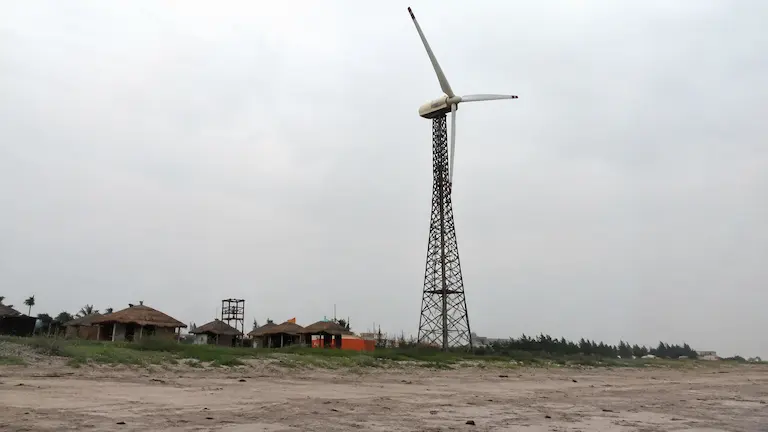
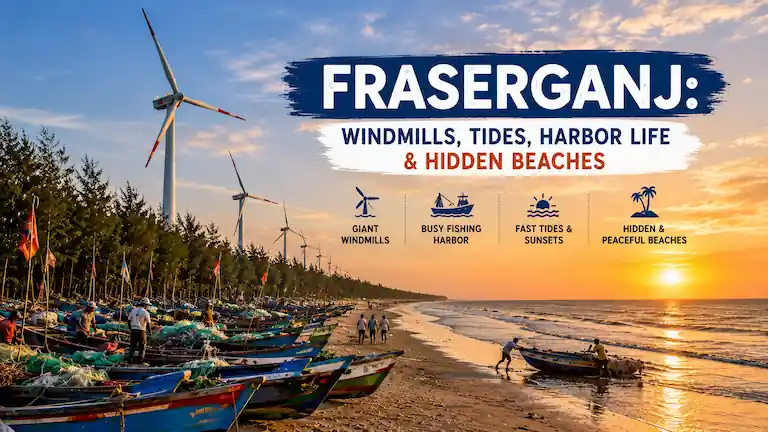
You can’t miss the massive row of giant windmills standing right along the edge of the coast when you roll into town. This is the Fraserganj Wind Park. It was originally built to send clean power to remote delta villages using the heavy sea breezes.
You can walk right up to the base of these huge white towers. A few of the older ones don’t spin anymore due to heavy storm damage and saltwater rust, but they still look awesome against the open sky. Take a walk down the surrounding paths lined with tall Casuarina trees that rustle whenever the wind picks up.
Believe it or not, you can watch the sun come up and go down from the exact same spot on this beach. It sounds impossible for the east coast of India, where you usually only see the morning sunrise over the water. But the coastline here takes a unique turn and faces straight south. You can literally sit in the sand and watch the sun pop out of the ocean at dawn, then hang out until evening to watch it drop right back into the same waves.
If you plan on walking out along the coast, you seriously need to check the daily tide timings first. The sea floor here is incredibly flat and shallow for miles, which causes the ocean to rush back in at a scary speed twice a day.
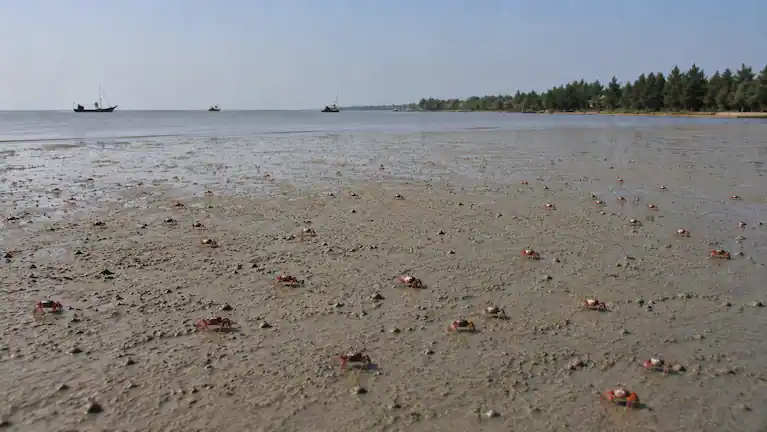
The ocean pulls back for a kilometer or more when the tide goes out, leaving a massive, flat plain of hard mud and wet sand. If you want to go for a long walk or ride a bicycle right along the shore, this is the best time to do it.
Keep your eyes on the ground—there are millions of tiny red ghost crabs here. From far away, they look like a giant, moving red carpet. The split second they feel your footsteps vibrate through the sand, they completely vanish right into their tiny mud burrows.
The real trouble is that high tide rushes back in incredibly fast. The incoming waves completely swallow up the flat beach and push the water all the way up to the tree line. Your biggest threat comes from the hidden sandbanks. The water always fills up the low-lying channels behind those sandbanks first, which can easily trap you out on a temporary island before you even realize what is happening. Always ask your hotel front desk about the exact daily tide charts before walking far from the tree line.
To get a real look at raw coastal life, spend a morning walking around the fishing harbour. It sits right at the northern edge of town along a protected river creek and acts as a massive hub for deep-sea fishing in the Bay of Bengal.
The harbor is packed with color. You will see the water lined with huge wooden and metal trawlers painted bright blue and red. The crews take these incredibly tough vessels way out into the open sea for weeks at a time before returning to unload their haul.
Set an early alarm and get here by 6:30 AM or you’ll miss the action. This is exactly when the boats start dumping massive baskets of fish packed in ice straight onto the concrete docks. The whole place turns into a loud, fast-paced market with merchants screaming out bidding prices for fresh Hilsa, Pomfret, and giant prawns.
Before you leave, check out the shipyards right next to the docks. You can walk right through them and watch local craftsmen building and fixing the huge wooden boats completely by hand using old methods and basic hand tools.
Kargil Beach sits right below the wind park, but don’t head down here looking to sunbathe or go for a casual swim. It is entirely a working shoreline used for preserving fish.
During the winter fishing months (October to February), the whole beach turns into a massive outdoor processing center. Fishermen hang thousands of fish across tall bamboo structures called khutis to let them dry out naturally under the intense coastal sun.
Because the beach borders the Sundarbans mangroves, rare wild birds show up constantly to hunt for fish scraps. If you bring binoculars, you can easily spot White-Bellied Sea Eagles flying wide loops near the windmills, alongside bright Kingfishers and large flocks of migratory shorebirds.
If you want to look around, just hire a local Toto driver. Here is where you should go:
Leave Kolkata by 6:00 AM on NH 12 so you don’t get stuck in traffic. You will cross the Hatania-Doania Bridge around 9:30 AM and reach Fraserganj by 10:30 AM. Check into your hotel and grab a fresh fish thali for lunch.
Wait for the afternoon heat to drop, then head to the Fraserganj Wind Park. Walk through the trees down to the hard beach. Because the coast faces straight south here, you can actually sit on the sand and watch the sun set directly into the ocean.
Get to the fishing harbor by 6:30 AM. This is when the boats bring in the fresh catch and the loud fish auction starts. After that, walk to Kargil Beach to see how locals dry fish in the sun. Keep an eye out for big sea eagles hunting nearby.
Check out of your hotel and drive over to Henry’s Island. Climb the tall watchtower, take a walk through the mangrove trees to Kiran Beach, and eat lunch at the government fisheries restaurant. After that, start your drive back to Kolkata.
Because of heavy tropical storms and salty air, hotels here are built out of plain concrete to survive the elements rather than offer high luxury.
Your best bet for a safe, reliable stay is the government-run properties. The top choice is the Benfish Tourist Lodge (Sagar Kanya & Sagari) located right on Susni Island in Fraserganj. It offers clean AC rooms, secure gated parking, a beautiful lawn, and an on-site kitchen that cooks fresh local catches to order.
If Benfish is fully booked, check out the West Bengal Tourism development property in neighboring Bakkhali (Balutot Tourism Property). Reliable private concrete hotels along the main road include Hotel Amarabati and Hotel Dolphin.
Pro-Tip: Always call private hotels ahead of time to confirm they have functional diesel generators. Power cuts are frequent during summer evening storms, and AC units will not run without a heavy backup generator.
Food here is cheap because it comes straight from the fishing boats. For lunch, just walk into any small “pice hotel.” A basic fish thali costs around ₹120 to ₹180. You get a huge plate of rice, dal, and fish curry. Obviously, if you order expensive fish like Ilish or Pomfret, it will cost closer to ₹180.
In the evening, head down to the beach shacks. They keep raw tiger prawns, crabs, and fish out on tables. You just pick what you want, they mix it with spices, and fry it on the spot. A plate costs between ₹60 and ₹150 depending on the size.
Walk past the fishing harbor and the proper road just ends. If you follow the dirt tracks from there, you will find some totally empty beaches. Tourists never come this far. There are zero shops or tea stalls around.
One big warning: be very careful where you walk. There is no help or lifeguard out here. The beach looks solid on top, but a lot of it is actually thick mud. Your feet will sink right in before you even notice. Just stay close to the trees, do not go alone, and definitely leave before sunset.
Fraserganj is a very basic village. If you forget to bring something, you probably won’t find a shop selling it here. For your feet, skip the regular flip-flops. The mud on the beach is so sticky it will just break the straps. Don’t walk barefoot either. Sharp tree roots and broken shells hide in the mud and can cut your feet. Just wear old sports shoes or strong sandals with a back strap.
When you walk near the windmills, there is absolutely no shade. You will definitely need a hat and sunscreen. Most importantly, buy a good mosquito repellent before you come. As soon as it gets dark, the sandflies and mosquitoes near the bushes get really bad.
This coast ties straight into the Sundarbans delta network. It is a wild environment, and ignoring local rules can get you into trouble fast.
It is always smart to know where to find a doctor when you are in a remote village. Keep these two places in mind just in case:
If you want fancy cafes, big hotels, and loud beach parties, skip Fraserganj. You will not like it here. But if you want to see real village life, watch fishing boats, and enjoy complete silence, it is one of the best weekend trips from Kolkata. For more hidden gems and travel inspiration, browse our complete collection of destination guides.
Mostly for the big windmills right by the water and the fishing harbor. The beach sand is also surprisingly hard. It is so packed down that you can actually ride a bicycle on the beach without sinking.
No, the ferry days are over. The Hatania-Doania bridge at Namkhana is fully open now. You can just drive your car or bike straight down without any stops.
Namkhana station. It is about 24 kilometers away from the actual beach. You can catch a direct local train from Sealdah in Kolkata. Once you get off, just hop in a shared Toto or bus outside the station to cover the rest of the trip.
Absolutely not. You won’t find jet skis, boat rides, or anything like that here. It is strictly a working fishing beach. Come here for walking and bird watching, not water sports.