
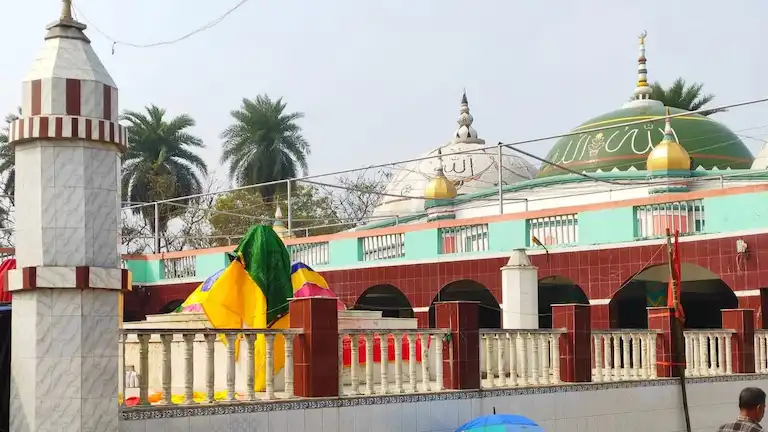
Most people visiting Purba Medinipur drive straight to Digha or Mandarmani. Want to skip those noisy beach crowds? Visit Hijli Sharif in Khejuri instead.
This 400-year-old shrine is in Nijkasba village, where the Rasulpur River meets the wide Hooghly river mouth. Inside is the tomb of Taj Khan Masnad-e-Aala. People across Bengal believe honest wishes come true here.
Almost every website gets this map wrong. They give you the wrong railway line and tell you to drive across a wide river with no bridge! Here is the real history from old Midnapore records, what you will see on the ground, and how to plan your trip without getting lost.
Quick Facts: Hijli Sharif
| Feature | Ground Detail |
|---|---|
| Name & Tomb Date | Tomb & Mosque of Taj Khan Masnad-e-Aala (Hijli Sharif Dargah); tomb stone dated 1555–1556 CE |
| Address & Map Note | Vill. & P.O. Nijkasba (via Janka S.O.), Nijkasba GP, Block Khejuri II, Purba Medinipur – 721431 (Map apps often show Pratappur or Dakshin Ali Chak) |
| Open Hours & Entry | 6:00 AM – 7:00 PM daily (busy Fridays). Free entry & free dirt parking at the gate |
| Offerings | ₹20–₹50 for mannat thread & flowers; chadar cloth, shirni sweets & Hajat Rice (Tabarruk) |
| Main Yearly Fair | Urs Mela on 1st Saturday of Bengali month Chaitra (mid-March, 1,00,000+ people) |
| Highway Turn | Henria More on NH116B (~23 km via Tikashi, Bidyapith Bazar, Janka & Shyampur) |
| Boat Crossing | 15-min bhutbhuti boat across Rasulpur River (Petuaghat / Pratappur Ghat to Hijli Ghat) |
| Last Fuel & Medical | Janka (~7.2 km away): Sayampur Petrol Pump, Janka Hospital & Khejuri Police Station |
The History: Local Stories vs. Old Records
Online dates for the Hijli Kingdom are a mess. People also mix up Hijli Sharif in Khejuri with Hijli in Kharagpur (115 km away, near IIT Kharagpur and the old Hijli Detention Camp).
Why the same name? Kasba Hijli (now Nijkasba village) was the kingdom’s rich island sea port. So Mughal and British rulers named the whole tax land (Hijli Chakla) after it, right up to Kharagpur. Big cyclones and river floods later wiped out the old forts and palaces. Only the mosque and tomb are left.
1. The True Timeline: From the Bahiri Kings to Taj Khan (1505–1628 CE)
Most websites repeat a big mistake. They say Taj Khan ruled in 1628 under Emperor Shah Jahan—wrong by almost 100 years! Two old records show the true dates: Mahendranath Karan’s 1926 book Hijlir Masnad-i-Ala (edited by Sir Jadunath Sarkar) and British Collector Crommelin’s 1816 report.
The Early Hindu Capital at Bahiri
A Hindu royal family ruled this coast from Bahiri (near Deulpota and Contai) before Pathan kings came. Prince Bhimsen Mahapatra belonged to this family.
Taj Khan & Sikandar Pahlawan
Selim Khan took power around 1505 CE. His sons Dawood Khan and Taj Khan Masnad-e-Aala built a rich Pathan kingdom across Amarshi, Pratapadighi, Gumgarh, Naigaon, and Sabong. Younger brother Sikandar Pahlawan led their army.
The Palace Coup & How Pratappur Ghat Got Its Name (1556 to 1594 CE)
Taj Khan’s son Bahadur Khan became king next. In 1564, Taj Khan’s son-in-law Zail Khan (Jain Khan) and court officers stole the throne for 10 years (1564–1573 CE). Bahadur Khan won his crown back in 1574 under the name Isa Khan Masnad-e-Aala. He ruled until 1594 as one of Bengal’s 12 Baro-Bhuyan chiefs. Maharaja Pratapaditya of Jessore later killed Isa Khan in battle and parked his war boats (ranatari) at the Rasulpur River mouth. Locals still call that spot Pratappur Ghat.
The 1611 Estate Split & 1628 Capital Move
Emperor Jahangir’s Mughal army took over by 1611 CE. Their governor split Taj Khan’s land between two Hindu court officers: Dibakar Panda (Jalamutha royal estate) and Dwarkadas, or Ishwari Pattanayak (Majnamutha estate). Under Emperor Shah Jahan in 1628 CE, the Mughals moved the capital from Bahiri to Kasba Hijli port and made it a 28-mahal Hijli Faujdari (1628–1649 CE) under Odisha.
2. The Spiritual Story: The Saint of Amarshi
In the courtyard today, the local caretakers (Khadims) do not talk about port taxes. Their families have guarded this shrine for generations. Instead, they tell how Taj Khan gave up his crown for God.
Local stories say Taj Khan gave daily kingdom work to his brother Sikandar so he could pray all day. When Sikandar died in a family plot, sad Taj Khan left the throne. He became a follower of Amarshi’s famous Sufi saint, Hazrat Makhdum Shaikh-ul-Mashaikh Shah Abul Haq Chishti (Wikipedia spells this wrong as “Mackdram Sha Chisti”).
Soon after, Taj Khan sat inside his small prayer room (hujra) right in front of the mosque. He went into deep prayer and passed away there. Locals believe his true faith makes this ground holy today.
3. The 1679 British Ship Falcon & Job Charnock’s 1687 Secret Tunnel Trick
Deep river water soon brought European traders here. In 1679, the Falcon became the first British East India Company ship to stop at Hijli.
During the Anglo-Mughal War (February to June 1687), British agent Job Charnock held Hijli island fort. Mughal general Abdul Samad blocked the fort for 4 months. Hunger, malaria, and cannon fire killed Charnock’s men every day.
On June 1, 1687, one small ship from England brought a few new soldiers. How did Charnock trick the Mughals? He marched those men in bright uniforms from the river jetty to the fort so the Mughal camp could see. Then he sneaked the same men back to the jetty through a secret underground ditch (guptapath) to march in again all afternoon! Abdul Samad thought a big British army had arrived. He asked for peace and signed the Treaty of Hijli in June 1687. After that, Charnock sailed north up the Hooghly River to Sutanuti and started Kolkata.
Why is Hijli Sharif Called the “Miraculous” Dargah?
People travel for hours down village roads to visit this shrine. Why? Deep faith.
Everyone believes praying here brings help in hard times. At the gate stalls, visitors buy a red or yellow wish thread. They tie it to the old tree branch in the yard and make a quiet wish.
Did the wish come true? Then families return to say thanks. They untie a thread and put a holy cloth over the grave. After that, they share blessed rice and sweets with everyone sitting in the mosque yard.
The Architecture of the Dargah
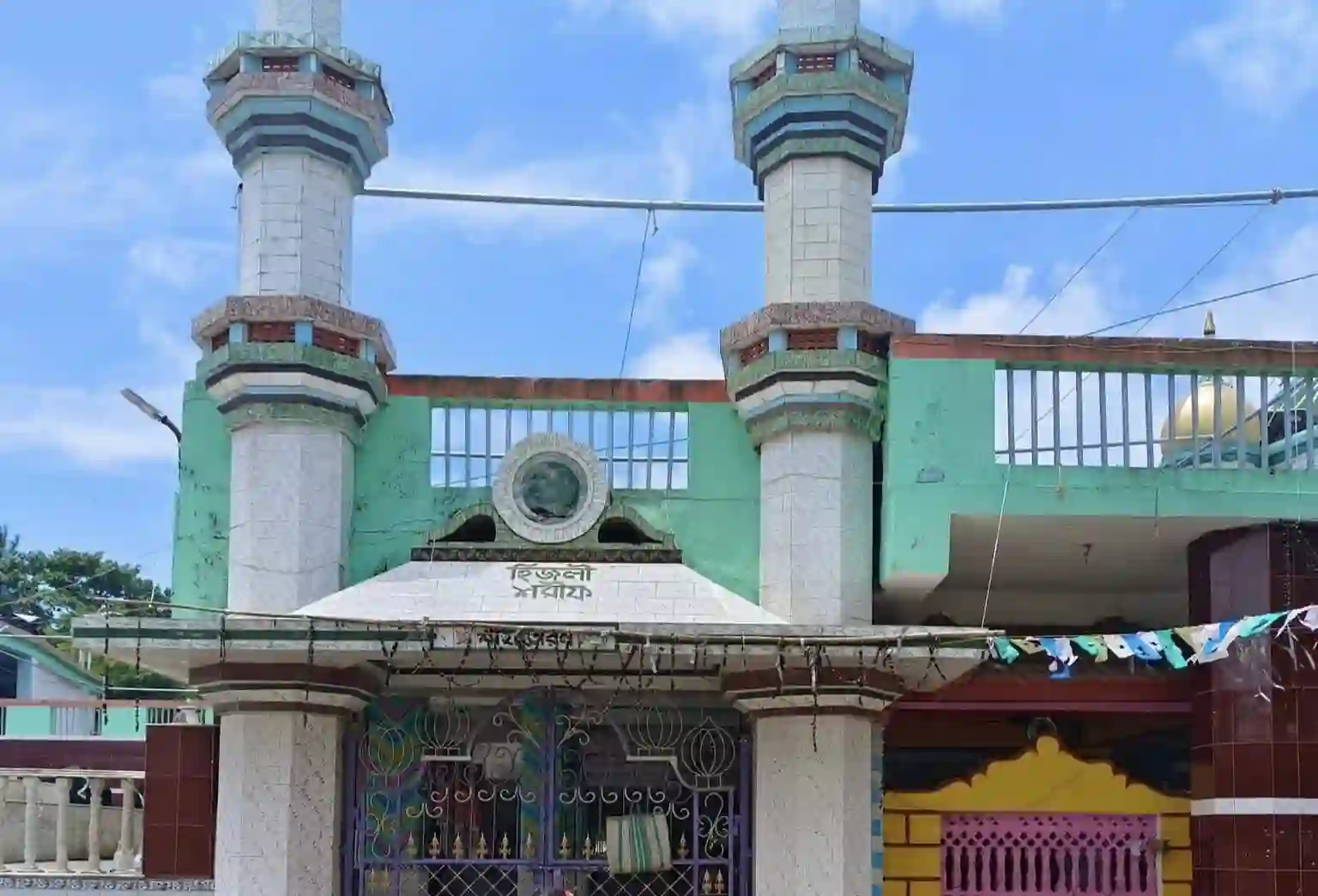
Walk past the main gate and you will see how old this place is. Three main spots stand inside the yard wall:
The Three-Domed Mosque
This old mosque has three round roof domes and short corner towers. It is made of small baked bricks and thick lime plaster. Even on hot summer afternoons, the thick walls and cool river wind keep the prayer room cold.
The Hujra Tomb Room & Stone Inscription
Right in front of the mosque is the green-and-white tomb room. Taj Khan and his family are buried here. Above the arch sit old carved stones from the 1940 Banglay Bhraman survey and 1951 Midnapore District Census Handbook.
Sikandar’s 40-Kg Iron Asabari (আশাবাড়ি)
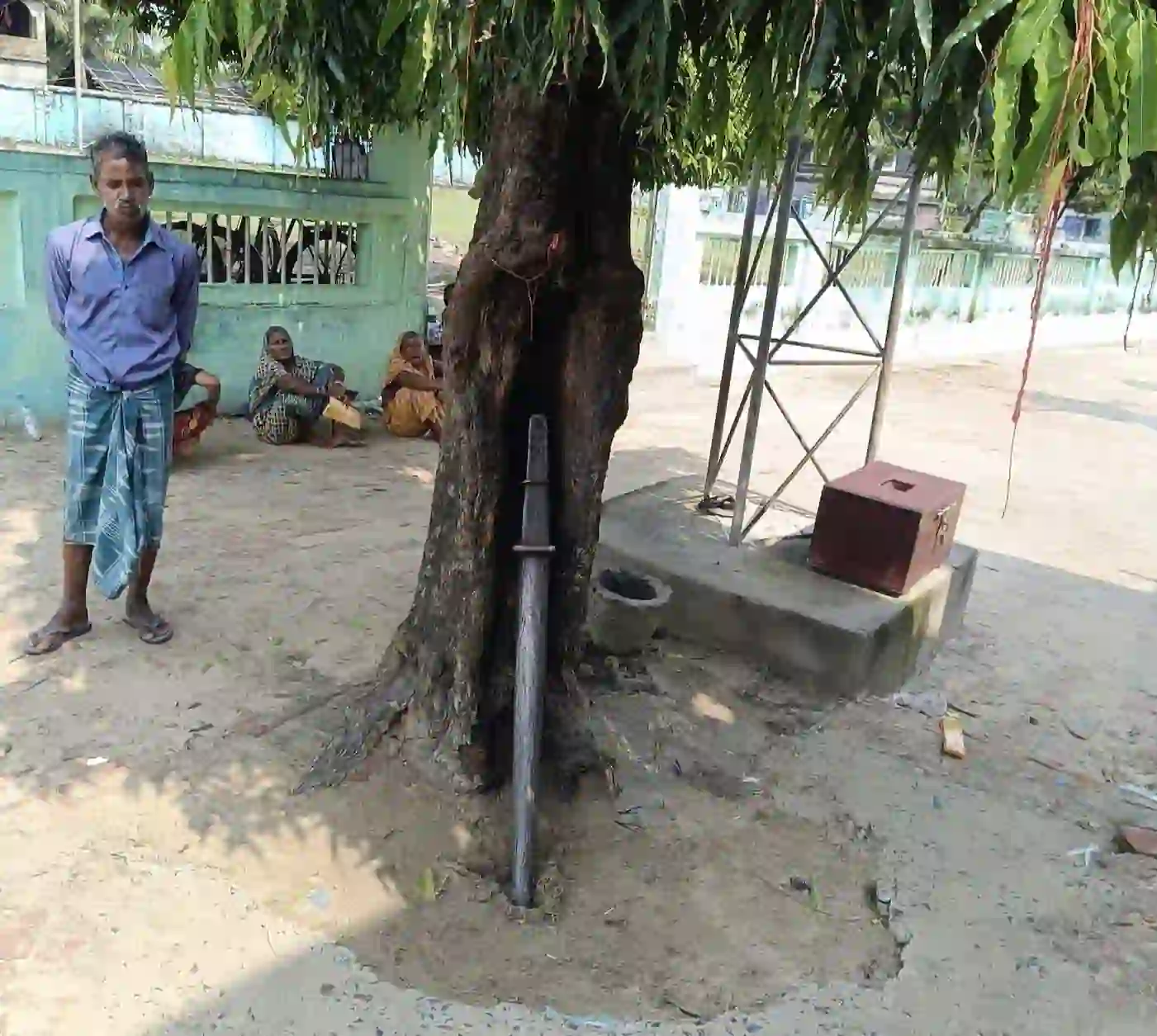
Under the wish tree outside the tomb, a heavy iron rod sticks out of the ground. It is 3 feet tall and almost 40 kg! People call it Sikandar Khan’s Asabari (his royal iron walking stick). Historians say it is really an old ship’s iron anchor rod (shank) from Hijli’s sea port days.
The Annual Urs Festival
Nijkasba village is very quiet on normal weekdays, until the yearly Urs Mela begins.
Most fairs follow the moon calendar, or lunar calendar, but Hijli Sharif’s spring Urs Festival follows the Bengali sun (solar) calendar instead. Visitors from West Bengal and Odisha come to camp in the fields for days. Small stalls line the road selling hot jilipi, sweets, clay toys, glass bangles, and fresh flowers.
Things to do near Hijli Sharif (The Khejuri Historical Circuit)
Going all this way just for a 20-minute shrine stop and heading back? Make it a full-day coast trip, but know one big map rule first.
The Rasulpur River Divide: Khejuri II Block holds Hijli Sharif on the Rasulpur River’s east bank. Across the water, Contai Block on the west bank has Petuaghat, Dariapur Lighthouse, and Kapalkundala Temple. No road bridge crosses this 3-km river mouth. Cars cannot drive straight across!
Part A: On the Khejuri Side (Same Bank as the Dargah)
Hijli Sea Beach & Mangrove Forest (500 m behind the Dargah)
The Rasulpur River meets the sea right behind the shrine. It looks like the quiet Pichaboni River mudflats with green grass, casuarina trees, and Hijal mangrove trees. Those Hijal trees gave Hijli its name!
Best Tide Timings at Hijli Beach

High tide comes at 8:00–9:00 AM and 4:00–5:00 PM. Water rises up the mangrove trunks then, so sit on a low branch and dip your feet! Midday water goes far out like Chandipur beach. Kids play football on the hard wet sand.
Khejuri First Telegraph Office Ruins (9 km away)
Head north up the village road for these red-brick ruins. Dr. William O’Shaughnessy built India’s first working electric telegraph station here in 1851–1852 to link Khejuri with British Calcutta.
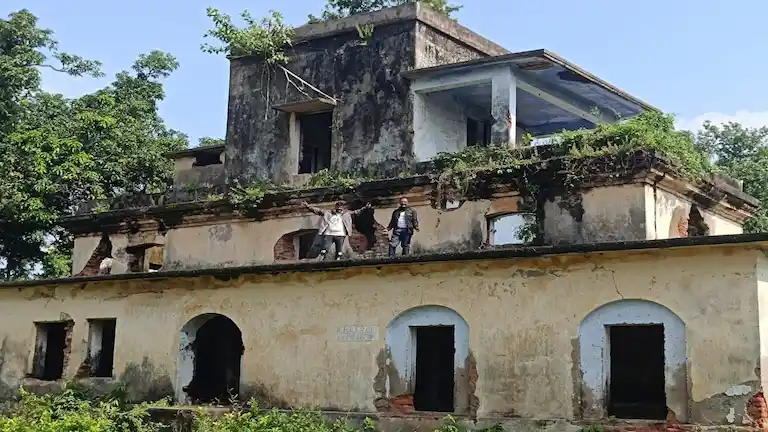
Kaokhali Abandoned Lighthouse & 33-Tomb British Cemetery (8 km north)
Tourists miss two old British spots 5 miles north of Kasba Hijli at Kaokhali (Cowcolly). You will see the 80-foot, 5-story Kaokhali Lighthouse (Bengal’s oldest brick lighthouse, built 1810, closed 1923). Nearby is the walled Khejuri British Burial Ground with 33 British graves (17th century to 1865).
Nilkumari Maa Temple
Driving back to the highway? Stop for 15 minutes at this popular village temple right on the Henria–Khejuri road.
Part B: Across the Rasulpur River (By Boat Ride)
Skip the 45-km drive via Kalinagar Bridge. Park at the jetty and take a motorboat from Hijli Ghat to Petuaghat.
Deshapran (Petuaghat) Fishing Harbour
The boat drops you at one of eastern India’s biggest fishing ports. You will see deep-sea trawlers and busy morning fish auctions here.
Dariapur Lighthouse (~1.5 km from Petuaghat Ghat)
This is a 96-foot working lighthouse. It opens from 3:00 PM to 4:00 PM (until 5:00 PM in winter). A ticket costs ₹10. Climb to the top for great views of the Bay of Bengal and Rasulpur river mouth.
Kapalkundala (Bhairavi) Temple & Siddheswar Shiva Temple (~2.5 km from Petuaghat)
Writer Bankim Chandra Chattopadhyay (Contai’s Deputy Magistrate) stayed in nearby Daulatpur and set his 1866 novel Kapalkundala here. The book had no temple, but locals call Dariapur’s old brick Bhairavi Devi (Chandi) Temple the “Kapalkundala Temple.” Pariyari priests have served here for 19 generations, guarding an old sacrificial sword (kharga). The rebuilt temple has no idol today. Right next door is the 18th-century Siddheswar Mahadev Temple, built by Raja Jadabram Roy of Kishorenagar. A huge fair happens here every 1st Ashwin.
Extend Your Coastal Drive
Read our Bankiput & Dariapur Coastal Guide for routes to Junput Beach and full visiting rules.
How to Reach Hijli Sharif Dargah
Hijli Sharif sits at the south end of Khejuri. It is on the official Purba Medinipur Tourism page. You can reach it by car, bus, train, or ferry.
Route 1: From Kolkata (Approx. 145–155 km)
By Car (3.5 to 4 Hours):
- Take NH16 (old Mumbai Road) past Dhulagarh to Kolaghat. Then turn onto NH116 toward Nandakumar.
- At Nandakumar, turn left onto NH116B toward Digha. Drive past Chandipur.
- Turn Left at Henria More: Do not drive to Contai. About 22 km before Contai (and before the Kalinagar bridge), turn left at Henria More (হেঁড়িয়া মোড়) onto the Henria–Khejuri–Boga Road.
- The Final Stretch: Drive straight on this road through Tikashi, Kalagachia, Bidyapith Bazar, Janka, and Shyampur More directly into Nijkasba.
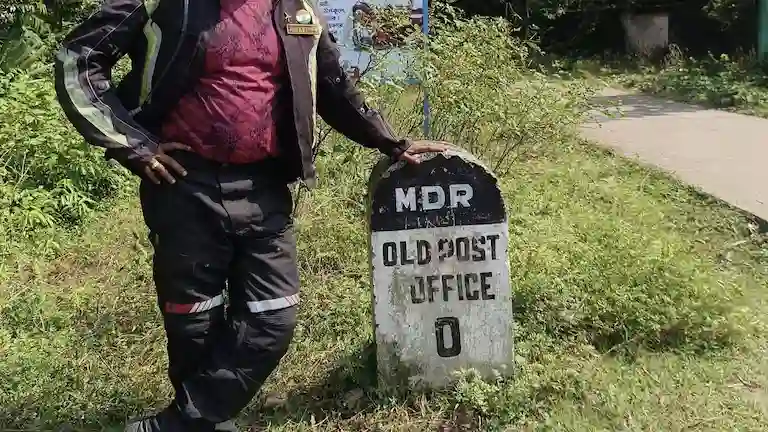
By Bus from Kolkata:
- Take any WBSTC, SBSTC, or Digha bus from Esplanade or Santragachi. Get off at Henria More on NH116B. Catch a shared auto or local bus to Shyampur or Boga. From there, a ₹20 to ₹30 Toto drops you at the gate.
- Direct private buses also run from Salt Lake Karunamoyee (via Airport, Dunlop, Kolaghat, and Henria) straight to Khejuri and Boga.
By Train (For Backpackers): Do Not Book “Contai Road” (CNT)!
Many websites give this wrong advice. That station is in Belda (Paschim Medinipur) on the Odisha line, over 70 km away. Use the Howrah/Santragachi to Digha line instead.
Also, Express trains like the Tamralipta and Kandari skip Henria station. They only stop at Tamluk and Kanthi P.H. Pick your drop-off point based on your train:
- If Taking a Local / MEMU Train (Get Down at Henria – HEN): Use the morning Santragachi–Digha MEMU (leaves 6:10 AM, reaches 9:36 AM) or Mecheda–Digha Local. From Henria station, take a Toto to the bus stand. Board a Boga-bound bus or shared auto (₹30–₹40) to Shyampur or Boga, then take a Toto to the shrine. A direct, booked Toto from Henria costs ₹250–₹350.
- If Taking an Express Train (Get Down at Kanthi P.H. – KATI): Get off at Kanthi (Contai). Go to Contai’s Rupashree More and take an auto 14 km to Petuaghat. Finally, cross the river by boat to Hijli Ghat.
Route 2: From Durgapur (Approx. 235 km)
Take the Bankura–Beliator–Sonamukhi road toward Arambagh. Then, use the Ghatal–Panskura road to join NH16. From Mecheda or Kolaghat, drive to Nandakumar and get on NH116B. Finally, turn left at Henria More to reach Khejuri. The drive takes about 5 to 6 hours.
Route 3: From Digha / Mandarmani
You have two options:
- Via Petuaghat Jetty (~45 km from Digha / ~30 km from Mandarmani): Drive through Contai’s Rupashree More to Petuaghat Harbour. Park there and cross the river by boat.
- By Road (~80 km from Digha / ~55 km from Mandarmani): Drive north on NH116B past Contai and Kalinagar Bridge. Turn right at Henria More, then take the Khejuri–Boga road to the gate.
Where to Stay Near Hijli Sharif
Nijkasba is a small fishing and farming village, not a resort town. Old websites still copy five “Panthanivas” guest houses from an old print book, so do not show up at sunset looking for beach hotels. Your real stay options:
- At the Shrine (For Pilgrims Only): The Dargah Committee runs a basic Musafirkhana (pilgrim rest rooms) inside the yard for devotees.
- Government & Camp Stays in Khejuri: The Khejuri side has the Khejuri Panchayat Samiti Guest House near Kamarda and winter tent camps near Boga. If you want to put up your own tent on the Hijli sand dunes, get permission first from the local police, Nijkasba Forest Office (Bajkul Range), or Khejuri-II Block Office.
- Best Option for Families & Road-Trippers: Stay at a hotel in Kanthi (Contai) town, 20 km across the river. You can also book Dariapur/Bankiput homestays or beach resorts in Digha and Mandarmani.
Essential Travel Logistics & Timings
Finish your trip before 5:00 PM. Why? The village roads and river banks have no streetlights after dark. You’ll find basic toilets and water taps near the shrine gate, but bring your own bottled water.
You won’t see big restaurants nearby. Small village shops at the Dargah, Boga Bazar, and Janar Bazar serve hot meals of rice, dal, veggies, and fish curry for ₹70 to ₹120.
Stop in Janka to fill your tank at Sayampur Petrol Pump, Khejuri’s last fuel stop. Khejuri Police Station and Janka Hospital (the Khejuri Block Primary Health Centre at Tengramari) sit on this same main road. Mahendranath Karan actually started this hospital back on May 20, 1916 as the Janka Alexandra Charitable Dispensary.
Top Tips for First-Time Visitors
You need to leave your shoes at the racks before walking onto the mosque verandah or the inner tomb yard. Going inside? Wash your hands and feet at the water taps first. Phone network drops near the river mouth, and the small village stalls outside only take cash. Keep ₹10, ₹20, and ₹50 notes in your pocket.
People come here for serious prayer. Put your phone on silent, and please do not take photos of anyone while they pray. Also, never drive your car or bike onto the soft sand dunes at Hijli Beach. Your tires will sink right into the wet mud.
The Verdict: Why You Must Visit
If you want to avoid crowded beaches, Hijli Sharif is a great choice. It is just as quiet as Bankiput. You can really feel the local faith and old history when you stand inside the courtyard.
Take a drive down the Khejuri peninsula instead of the usual tourist spots. You get to see a calm river mouth, the old British ruins of Kedgeree, and a shady shrine. This hidden part of Purba Medinipur is a really good trip.