Physical Address
Bankura, West Bengal 722142
Physical Address
Bankura, West Bengal 722142

Most people who visit the sea only go to the loud, crowded beaches of Digha. But just a short drive away is a quiet nature spot where the river meets the ocean—and regular tourists rarely see it. Subarna Island is a clean sand beach formed exactly where the Subarnarekha River flows into the Bay of Bengal. If you want to see wild, untouched nature, this is the best place to go.
As a travel writer, I regularly check holiday spots across Odisha and Bengal. In April 2026, I personally went back to this beach to update this guide. I can tell you firsthand: this place is truly amazing. You get to take smooth boat rides through thick mangrove forests right out to the open sea. You also get a rare chance to walk next to real “living fossils”—the ancient horseshoe crabs. To help you plan your day without any stress, I’ve put together the exact GPS locations, verified April 2026 boat times, easy science facts, and local tips you need for the perfect trip.
Subarna Island is a beautiful sand beach inside the protected Bichitrapur Mangrove Sanctuary in Odisha, India. The shape of the beach changes with the ocean tides. This makes it a shifting intertidal zone right where the Subarnarekha River meets the Bay of Bengal. Because the plants and animals here need extra care, marine biologists watch this beach very closely. Thick green mangrove trees grow all around the island. It is famous for thousands of little red ghost crabs (Ocypode macrocera) running on the sand. It is also a very important safe home where rare horseshoe crabs come to lay their eggs.
When you step off the small wooden boat onto this empty beach, you will not hear any noisy cars. You only hear the water moving past the breathing roots (pneumatophores) of the mangrove trees. During my field visit, the quiet sand beach was truly amazing. The only sound was the little red ghost crabs running away from my feet. On one side, the calm, muddy river flows by. On the other side, the big waves of the Bay of Bengal crash against the sand. Welcome to Subarna Island.
This is not a place for loud music or beach parties. In fact, the Odisha Forest Department does not allow them at all. It is a highly protected safe home. It protects winter birds (migratory avifauna), beach plants, and very old sea bugs (marine arthropods) that lived through times when even dinosaurs died. If you love nature or taking photos, you will really love it here.
Below, I will share easy science facts about the island and its local sea life (marine biology). I will also show you exactly how to plan your boat trip using the latest forest rules.
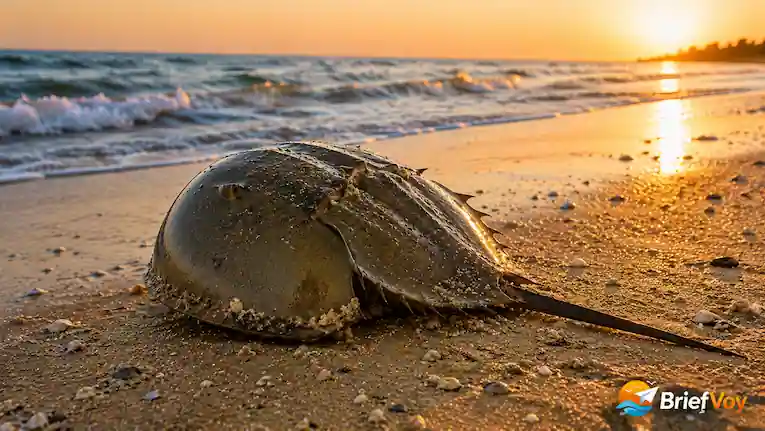
One of the best things about Subarna Island is its sea life. Most crowded beaches in India, like Bakkhali, only have normal little crabs. But the Subarnarekha River mouth (estuary) is famous worldwide because it is a safe home for a much older, rare animal: The Horseshoe Crab. Specifically, this area is home to the Indian horseshoe crab (Tachypleus gigas) and the mangrove horseshoe crab (Carcinoscorpius rotundicauda).
Animal experts (marine biologists) call horseshoe crabs “living fossils.” Old rocks show their family has been on Earth for over 450 million years! This means they were swimming in these waters hundreds of millions of years before the first dinosaur was born. They survived five major events that wiped out most life on Earth, and their body shape (morphological structure) has stayed exactly the same.
Even though “crab” is in their name, they are not normal crabs (crustaceans). In science (subphylum Chelicerata), they are actually closer relatives to modern spiders and scorpions. You will see a hard, helmet-like shell (carapace) and a long, stiff tail (telson). This tail is not a weapon to hurt you. It has a very simple, clever use: it acts like a lever to help them flip back over if a strong wave knocks them upside down.
Because this island has no factory pollution, scientists work here often. Experts from the Zoological Survey of India (ZSI) closely watch the crab couples that arrive during the highest tides.
Why are these animals so important? Similar horseshoe crabs in the Atlantic Ocean (Limulus polyphemus) have been used for years to make human medicines safe (biomedical testing). The Asian crabs found here share the same amazing blue blood. Protecting this exact sandbar’s perfect mix of fresh and salt water (salinity gradient) gives them the best, safest place to lay their eggs.
If you visit during the full moon high tides in late winter or spring, you might see them on the beach. Please follow these rules:
The horseshoe crab might be the biggest star of your trip, but you will see many other animals too. The area where the land meets the sea (intertidal zone) is a very busy natural home (ecosystem).
You need the right ocean tides to find a horseshoe crab. But you will definitely see thousands of little Red Ghost Crabs (Ocypode macrocera). When you walk on the wet mud (exposed mudflats), the beach looks like a moving red carpet. I saw huge groups of their little crab holes (burrows) near the water. These crabs are very important cleaners (scavengers). They keep the beach sand clean by eating dead plants and waste (organic detritus). But walk softly! They can feel the ground shaking (seismic vibrations). The second they feel your feet, they hide deep in their holes.
If you visit between November and February, the island becomes a busy winter home for traveling birds (migratory birds). They fly here from all over the world. The thick tree leaves (dense canopy) give them a safe place to sleep. During my morning boat ride, my big camera lens helped me spot them. I saw Black-capped Kingfishers diving for fish, Brahminy Kites flying high in the warm air, and Eurasian Curlews digging in the mud with their long beaks. Look closely at the tree trunks, too. You can often hear the loud hammering of the Black-rumped Flameback woodpecker before you see it.
You must take a boat through the Bichitrapur Mangrove Sanctuary to reach Subarna Island. The twisted roots of the local trees (Rhizophora mucronata) and the pencil-like breathing roots of other trees (Avicennia alba) act like a giant water filter. They trap heavy mud coming from the river. They also form a strong green wall (bio-shield). This wall protects the nearby villages in Odisha and Bengal from huge storm waves.
| Wildlife Found Here | Why It Matters to the Island |
| Horseshoe Crabs (T. gigas) | Very old sea animals whose special blood helps human doctors test medicines. |
| Red Ghost Crabs | Nature’s little cleaners. They eat dead waste and keep the beach sand perfectly clean. |
| Winter Birds (Migratory Avifauna) | They eat extra bugs, catch fish, and spread tree seeds through their droppings. |
| Mangrove Trees (Flora) | They trap carbon, stop the beach from washing away, and give baby fish a safe place to grow. |
Here are real facts from my trip that other travel guides miss:
Getting to the island means you must follow the ocean water schedules (tidal charts). You cannot drive a car to the beach.
The only legal way to go is on the official Eco-Tour Odisha boats. They leave from the Bichitrapur Mangrove Sanctuary. During my recent trip, our official boat driver drove through the shallow water very carefully. He showed us little walking fish (mudskippers) on the muddy banks before we reached the open sea. You will float through narrow water paths (tidal creeks) covered by thick green trees before stepping onto the sand. (Note: For a full guide on the forest route, please read my complete Bichitrapur Mangrove Guide.)
You must check a local water schedule (tide chart) for the river mouth (Subarnarekha estuary) or nearby Digha before you leave.
I personally checked the real ticket prices at the Khadibili ticket counter in April 2026.
| Trip Details | Real Facts (Verified April 2026) |
| Boat Cost | ₹1,200 for a wooden boat. You must book the whole boat. |
| Capacity | Only 8 people plus the boat driver. |
| Time (Duration) | 1.5 to 2 hours total. You get 30 to 45 minutes to walk on the island. |
| Where to Book | The Eco-Tour Odisha counter at Khadibili. No online booking. |
| Safety Rules | The Forest Department makes everyone wear life jackets on the water. |
Even though the island is in the Balasore district of Odisha, most travelers actually start their trip from West Bengal.
This is the fastest way to get there. The entrance to Bichitrapur is exactly 15 kilometers from New Digha on the coastal road. It is a 35 to 40-minute drive that crosses the state border. You can hire a private auto-rickshaw for the whole trip (including the time the driver waits for you) for about ₹600 to ₹800.
The nature park is about 95 kilometers away from Balasore city. Drive on the main highway toward Jaleswar. Then, take the exit toward Chandaneswar and just follow the local signs that point to Bichitrapur.
The closest big train stations are Digha in West Bengal (15 km away) or Jaleswar in Odisha (42 km away).
Because this island is completely wild, the weather changes everything. You have to pick your dates carefully.
There are no shops or buildings once you leave the Khadibili ticket counter. You must bring everything you need with you.
These simple, nature-friendly cottages are run by the government (Odisha Forest Development Corporation). They are located right at the boat dock. You can book them through the official website. Staying here is the best choice because you get to be the first ones on the boats in the morning.
Staying at Talsari Beach is about 8 kilometers from the boat dock. It is much quieter than the big nearby towns and has government-run guesthouses and private stays. It is a great way to avoid the big crowds.
If you need things like bank machines (ATMs), lots of restaurant choices, and fast internet, stay in New Digha. Just remember that it is a 40-minute drive to the boat dock, so you will need to leave very early in the morning.
Subarna Island is a very delicate natural home. Please follow these rules to keep it safe:
If you want to learn more about the animals and nature mentioned in this guide, you can check these official sources:
Based on my trip in April 2026, the signal is very bad once you enter the forest paths. Plan to be completely offline for your 2-hour boat trip.
Taking regular photos is perfectly fine and free! However, you are generally not allowed to fly a drone over the park. You need official written permission from the Forest Department because drones scare the birds away.
You can see them in deeper water all year, but your best chance to spot them on the beach is in late February and March. Look for them during the high tide days of the full moon or new moon, as that is when they come to the sand to mate.
No, never. The river and the sea meet here, which creates very dangerous water currents and shifting sand. The Forest Department strictly forbids swimming.
No. There is absolutely nothing on the island. You must use the toilets at the Khadibili boat counter on the mainland before your boat leaves.
No. If the tide is too low, the wooden boats will get stuck in the mud. Always check a local water schedule (tide chart) and try to visit when the water is coming in or is high.